
The three categories of water
Not all water is the same. The restoration industry uses a three-category system defined by the IICRC (the certification body our technicians train under) to decide what a crew can save, what has to be thrown out, and what PPE the team wears on site.
Getting the category wrong is how homeowners end up with mold six months later. Getting it right is how you keep your flooring, your drywall, and your lungs.
| Category | Source | What it contains | Required response |
|---|---|---|---|
| Category 1 — Clean | Supply line, broken tap, rainwater | Potable water, no contaminants | Extract within 24 hrs, dry in place. Most materials saved. |
| Category 2 — Grey | Dishwasher, washing machine, toilet overflow (urine, no solids) | Detergents, some bacteria, food residue | Extract immediately. Porous materials (carpet pad, some drywall) often removed. Antimicrobial applied. |
| Category 3 — Black | Sewage backup, river flooding, toilet with solids, any water sitting over 48 hrs | Pathogens, sewage, bacteria, heavy metals | Full PPE. Containment. Porous materials cut out and bagged. Often requires permitting. |
Here is the part most people miss: Category 1 water becomes Category 2 within 24 hours, and Category 3 within 48–72 hours. Clean water sitting on dirty subfloor picks up whatever is on that subfloor. That is why "I'll deal with it Monday" turns a $4,000 job into a $22,000 job.
Hour zero to hour one
The first 60 minutes set the ceiling on how much damage you take. Here is what is physically happening.
0 to 15 minutes
Water spreads. Fast. On a flat subfloor, a half-inch of water at a single leak point will travel 10 to 20 feet in the first five minutes, following the lowest contour of the floor. It wicks into baseboards within the first 30 seconds of contact. Drywall begins absorbing at the cut edge (the bottom, where it meets the baseboard) immediately.
15 to 60 minutes
Water moves upward through capillary action. Drywall absorbs water up to 12 inches above the waterline within the first hour. Wood subfloor fibers begin swelling. Carpet pad is already saturated; the carpet face is wet.
This is the window where a professional extraction saves the floor. Truck-mounted extractors pull 10 to 20 times the water a wet/dry shop vac gets. Every gallon pulled in hour one is a gallon we do not have to chase out of a swollen subfloor on day three.
Hours 1 through 24
Drywall paper backing peels from gypsum core. Wood trim warps visibly. Laminate flooring begins to cup and delaminate. Particleboard cabinet bottoms swell. If the leak is ongoing (not a one-time burst), any untreated Category 1 water is now Category 2.
Hardwood flooring develops "cupping" — edges curl upward because the bottom face is wetter than the top. At this stage, cupping is reversible with proper drying. After 48 hours it often is not.
This is also when the smell starts. That musty odor is not mold yet — it is bacterial growth in the carpet pad and drywall cavity. Mold follows it within 24 to 48 hours.
Hours 24 through 48
Mold spores begin germinating. The magic number the remediation industry cites is 48 hours, and it is accurate for most household molds (Stachybotrys, the "black mold" people worry about, needs 72 hours but it is already cooking at 48). Spores are everywhere in your house already — on every surface, in the air. What they need to grow is moisture, a food source (drywall paper, wood, dust), and a stable temperature between 40 and 100 °F. Your flooded basement has all three.
Warped flooring becomes permanent. Hardwood cups that would have dried flat on day one will now have to be sanded or replaced. Particleboard and MDF subfloor delaminates — the resin bonds fail and the board essentially becomes wet sawdust held together by the top veneer.
Electrical systems become a real risk. Any outlet or switch below the waterline should be considered compromised until a licensed electrician clears it.
Days 3 through 7
Mold colonies are now visible on drywall, wood framing, and any organic surface that stayed wet. The musty smell becomes a reliable indicator that spores are reproducing.
Structural wood loses strength. A saturated 2x10 floor joist loses roughly 15 to 20 percent of its load capacity at 30 percent moisture content (dry wood is 8 to 12 percent). Joists that stay wet for more than a week may need to be sistered or replaced.
Drywall that was sitting in water is now a total loss. Cut it out up to the waterline plus 12 inches. No exceptions.
What the crew actually does on site
Speed matters because every step of the process gets harder with time. Here is what a Long Island Restoration Co. crew does in the first two hours after arrival:
- Safety scan — Electrical shutoff if water is near outlets. Gas line check. Structural walkthrough for any ceiling sag or buckled flooring.
- Category assessment — Thermal camera + moisture meter survey to map the actual water footprint (usually 2 to 3 times larger than what is visible on the surface).
- Extraction — Truck-mount vacuum first, then portable extractors for corners and stairs. Every square foot gets at least two passes.
- Demolition (if needed) — Wet baseboards off. Drywall cut at 24 inches above waterline. Wet insulation bagged. Cabinet kick plates removed.
- Antimicrobial application — Every wet surface, including inside wall cavities via drilled access holes.
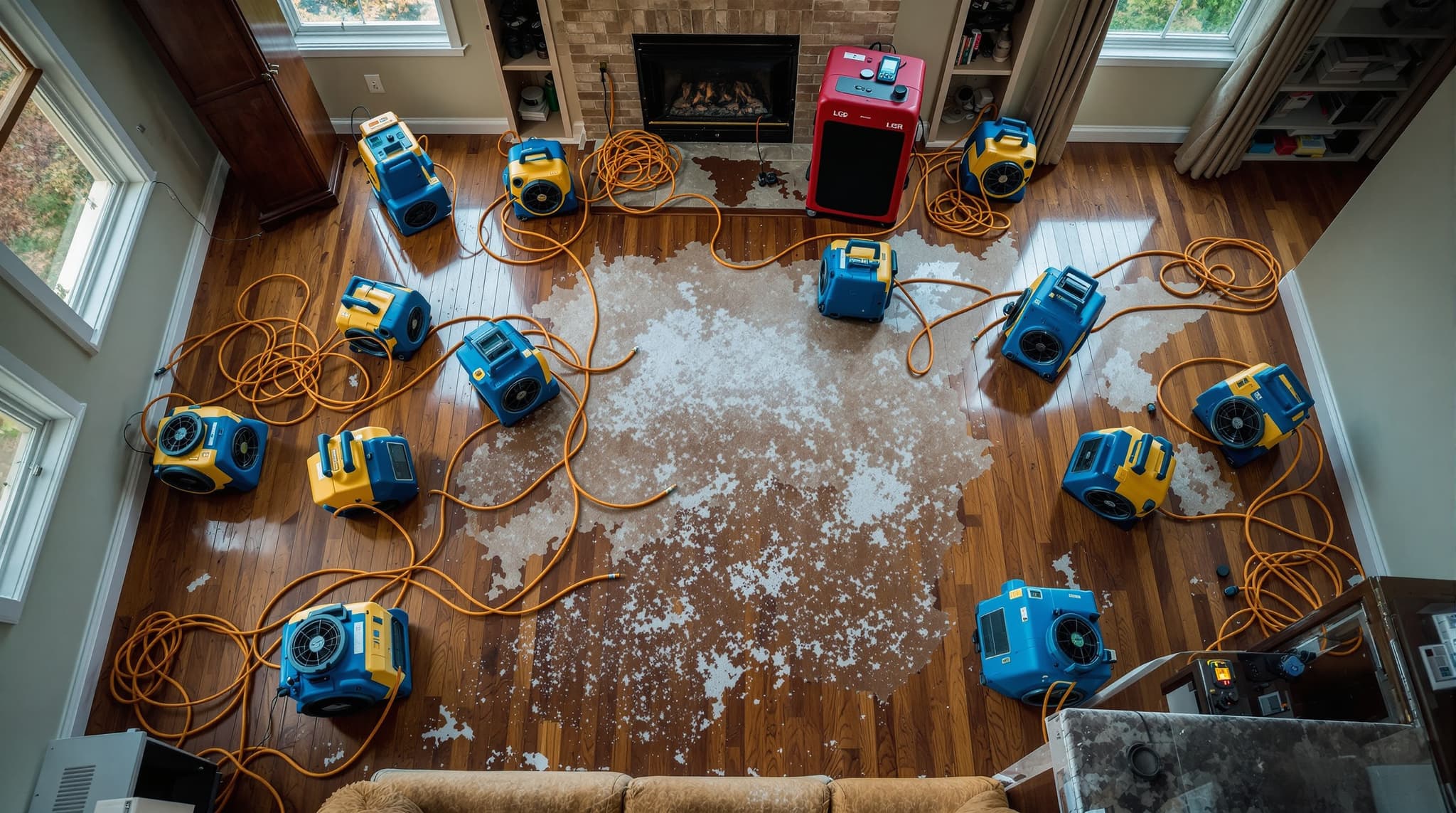
- Drying setup — Air movers (one every 50 square feet) and dehumidifiers (one 150-pint commercial unit per 1,500 square feet wet).
- Moisture mapping — Baseline readings on every wet material, logged with the claim file.
- Documentation — Photo log, thermal scans, and the moisture map go to the insurance adjuster before we leave the site.
We come back every 24 hours to re-read moisture levels until the structure is below 15 percent MC. That usually takes 3 to 5 days.
Why 60 minutes matters
Every restoration company promises fast response. Here is the math on why it actually matters, from the homeowner side.
A 60-minute response gets the extraction done before drywall has wicked more than 6 to 8 inches up the wall. That keeps you in a "dry in place" repair.
A 4-hour response means drywall is saturated 18 to 24 inches up and usually has to come out. Now you are looking at drywall replacement, insulation replacement, electrical inspection, and paint.
A 24-hour response means mold is already germinating in wall cavities. Now you are looking at remediation, not just restoration, and the cost doubles.
That is the entire argument for our dispatch model. Truck rolls from Nassau or Suffolk in under 60 minutes, 24/7, because the difference between hour 1 and hour 4 is not a service-level detail. It is the difference between a $6,000 job and a $28,000 job.
Call dispatch the moment you find water. Document what you can (photos of the source, waterline on the wall, affected rooms) while you wait. The rest is our job.