
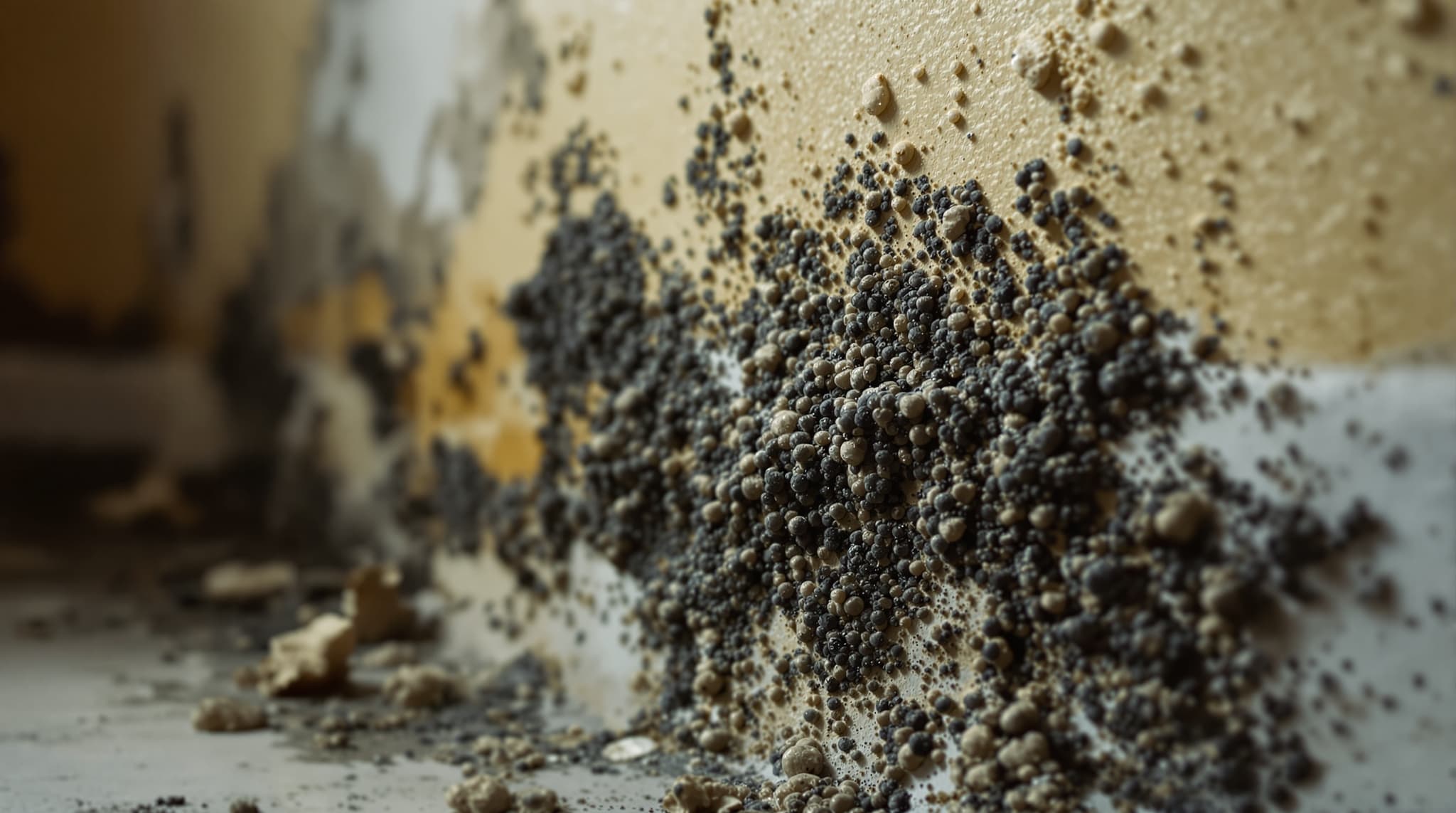
The 48-hour rule, explained
Mold does not appear out of nowhere. Spores are present in virtually every indoor environment year-round, drifting through the air, settling on surfaces, dormant. What they need to go from dormant to active is three things, all at once: moisture, a food source, and a temperature between 40 and 100 °F.
Your house has the food source (drywall paper, wood framing, dust, carpet backing) and the temperature. It is missing the moisture. When water damage happens, you hand over the third ingredient. The clock starts the moment water contacts an organic surface.
- 0 to 24 hours — Spores absorb water and begin hyphal growth (the filament that becomes the visible colony). No visible mold yet.
- 24 to 48 hours — Visible growth begins on drywall, wood, and other organic surfaces. Musty odor detectable.
- 48 to 72 hours — Colonies mature. Stachybotrys (the "black mold" people fear) begins producing mycotoxins.
- 7+ days — Colonies become established in wall cavities, under flooring, inside HVAC systems. Spore counts in the air spike.
The 48-hour rule is why every legitimate restoration company measures response time in minutes, not days. If we are on site in under 60 minutes and have drying equipment running in under 2 hours, the air and structural moisture come down fast enough that spores never get the sustained wet surface they need to colonize.
How to tell if mold is hiding in your walls
Mold on the surface of drywall is obvious. Mold behind drywall — in the wall cavity, on framing lumber, on the backside of the insulation — is how homeowners end up with a $20,000 remediation after thinking they dried a leak themselves. Here are the hidden signs.
You can smell it before you can see it
Mold produces MVOCs (microbial volatile organic compounds) that cause the classic "musty basement" smell. If a room smells musty but nothing is visibly wet or dirty, there is active fungal growth somewhere in that room's envelope.
The paint is doing something weird
Bubbling, peeling, or dark staining on painted drywall is a strong indicator of moisture (and often colonization) behind the paint. Healthy drywall in a normal room does not peel.
You or the family feel worse at home than away
Mold exposure causes upper respiratory symptoms that clear up when people leave the house and come back when they return. Kids, elderly family, and anyone with asthma feel it first. If the sinus infection clears up after a weekend away and comes back on Sunday night, that is a hint.
Thermal camera scan
A professional thermal scan (we run one on every assessment) shows cold spots in walls where moisture is still present even when the surface looks dry. Cold spots that persist 7+ days after a leak was "fixed" are where hidden growth lives.
Moisture meter readings above 17 percent
Wood and drywall above 17 percent moisture content will support fungal growth. Above 20 percent is actively wet. Any surface reading above 17 percent at day 5 post-leak needs to be opened up and inspected.
Professional remediation vs DIY
The internet is full of advice about spraying bleach on mold. The advice is wrong, and in some cases it is dangerous.
Why bleach does not work
Bleach kills surface mold on non-porous surfaces. It does not penetrate porous surfaces (drywall, wood, grout) where the hyphae actually live. You kill the visible fruiting body and the colony regrows from the roots in two weeks. Worse, bleach is mostly water, and applying it to a porous surface adds moisture to the food source the mold loves.
When DIY is acceptable
Small surface mold on a hard, non-porous surface (tile, glass, fiberglass tub) under 10 square feet, from a Category 1 water source, with no health symptoms in anyone in the household. Wear an N95, use a hydrogen peroxide solution (not bleach), and fix the moisture source.
When DIY is not acceptable
- Any visible mold larger than 10 square feet.
- Any mold from Category 2 or Category 3 water.
- Any mold on porous materials (drywall, carpet, wood framing, insulation).
- Any situation where anyone in the household has asthma, allergies, or immune suppression.
- Any HVAC contamination.
- Any suspected black mold (Stachybotrys — dark green to black, slimy texture).
Never, ever DIY Category 3 water damage. Sewage backups, river flooding, or water that has been sitting over 72 hours contain pathogens that cause serious illness. The cleanup requires full PPE, containment, HEPA air scrubbing, and bio-disposal protocols. A shop vac and a pair of rubber gloves will make you sick.
When it is past the DIY line, our mold remediation page explains how containment, removal and clearance work, and Category 3 water starts with sewage cleanup.
Mold severity levels, required action, and cost
The EPA and IICRC classify mold remediation jobs by condition level. Here is what each level means in practice, what the crew has to do, and what it costs on Long Island.
| Condition level | What it means | Required response | Typical Long Island cost |
|---|---|---|---|
| Condition 1 | Normal fungal ecology — no visible growth, no musty odor, no moisture issue | Document as baseline. No remediation needed. | $0 (just a $350–$600 inspection fee) |
| Condition 2 | Settled spores or fragments on surfaces from a nearby Condition 3 area. No active growth. | HEPA vacuuming, damp-wipe cleaning. Containment around any adjacent Condition 3 area. | $1,500 – $4,000 |
| Condition 3 | Active growth, visible or confirmed by lab. Any size, any surface. | Full containment with 6-mil poly and negative air machines. HEPA-filtered air scrubbers. Removal of porous materials (drywall, insulation, carpet). Antimicrobial treatment. Post-remediation verification (PRV) lab testing before reoccupancy. | $4,000 – $25,000 depending on square footage and material removal |
| Category 3 water + mold | Sewage backup that has sat long enough to colonize | Category 3 water protocols + Condition 3 mold protocols. Full PPE, permit-level demolition, bio-disposal. | $15,000 – $60,000 |
HEPA + containment is non-negotiable. A HEPA filter captures 99.97 percent of particles at 0.3 microns — the size range that mold spores fall into. Negative air pressure (more air leaving the contained area through the HEPA machine than air entering it) ensures spores cannot escape into the rest of the house during demolition. Crews that skip containment spread the problem from one room to the whole house.
Buying a house? Warning signs of past mold
Long Island's water table, aging housing stock, and hurricane exposure mean many homes have had at least one water event in their history. Most of the time this is fine — if it was handled properly. Sometimes it is hidden, and the new owner discovers it the hard way.
Signs to check during a walkthrough:
- Basement — any paint line on the walls (a horizontal line suggests a flood waterline that was repainted over). Check behind any freshly painted wall. Smell the air.
- Ceilings — water stains, even faint ones, indicate a past leak. A single repaired stain is fine. Multiple stains across multiple rooms is a pattern.
- Window sills and basement window wells — fresh caulk or recent paint here is a tell.
- HVAC — pull the filter. Mold smell in the supply registers means mold in the ductwork.
- Attic — look at roof sheathing for dark staining, particularly in the corners and around roof penetrations. Ventilation issues cause attic mold even without a leak.
- Crawl space — the highest-mold-risk part of most Long Island homes. Bring a flashlight, bring a mask, look at the floor joists from underneath.
Have a pre-purchase mold inspection done by an independent firm (not the home inspector, who is a generalist). A proper inspection includes air sampling for spore counts and a thermal + moisture scan of every exterior wall. Cost is $400 to $900, and it is money well spent on a $700,000 house.
Getting it handled
If you have a current water event, call dispatch and get a crew on site before the 48-hour window runs out. That call alone prevents most mold problems from ever happening. Our page on water damage restoration on Long Island covers what happens after that call.
If you suspect past mold from a leak that was "handled" without proper drying, schedule an assessment. A thermal scan plus moisture readings plus air sampling will tell you definitively whether there is an active problem. From there, the remediation plan is a matter of scope, cost, and schedule — not guesswork.
The single worst thing a homeowner can do with mold is wait. It does not dry out, it does not go away, and it does not get smaller. It grows until you stop it.