
The short answer
Water damage restoration on Long Island typically costs between $1,800 and $8,500 for residential jobs, with the average falling around $3,200. The range is wide because no two water events are the same — a contained washing machine overflow is a fundamentally different job from a basement that took on two feet of groundwater during a nor'easter.
Here's what drives the number:
- Category of water (clean vs. grey vs. black — more on this below)
- Square footage affected
- Materials involved (drywall, hardwood, carpet, concrete, insulation)
- How long the water sat before the crew arrived
- Whether mold is already present
The most important cost lever is response time. Every hour water sits before extraction multiplies the damage. A burst pipe caught in 30 minutes is a $1,500 job. The same pipe discovered 12 hours later, after water has wicked into wall cavities and subfloor — that's a $6,000 job with possible mold remediation on top.
Cost by damage type
Different water events have very different typical cost ranges. Here's what we see on Long Island jobs:
Burst or frozen pipe (clean water) Most common cause of indoor water damage on Long Island, particularly January through March when pipes in exterior walls and unheated crawl spaces freeze. Typical range: $1,500–$4,500. Scope depends on which room was affected and whether the pipe was discovered quickly.
Washing machine or dishwasher overflow (clean water) Usually confined to kitchen or laundry room. If caught quickly, this is often the cheapest category. Typical range: $800–$2,500. Can escalate if water reached under cabinetry or seeped into subfloor.
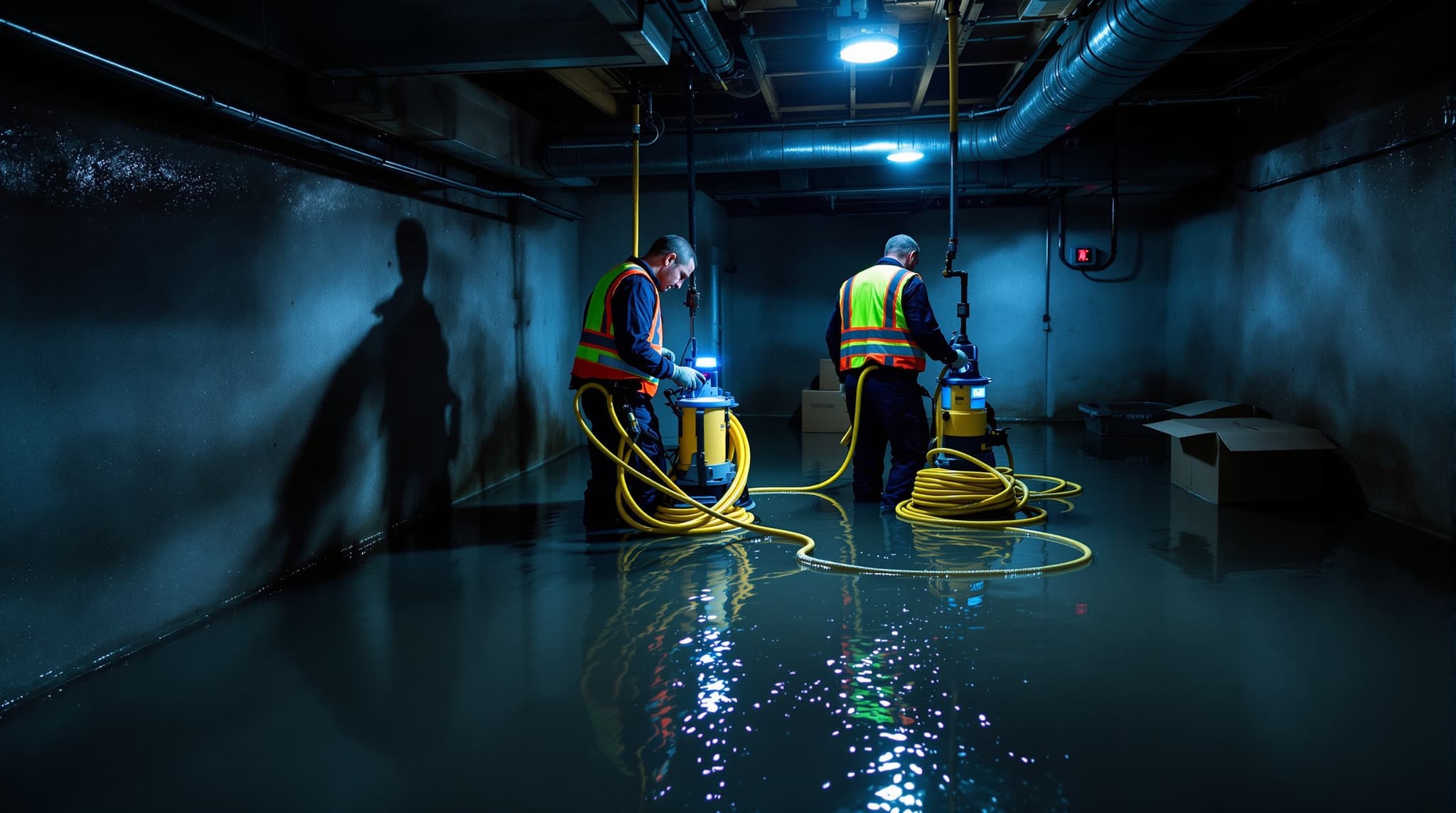
Basement flooding from storms or groundwater intrusion Long Island's shallow water table makes this a real risk, particularly in low-lying areas of Nassau County (Oceanside, Valley Stream, Freeport) and Suffolk County (Bay Shore, Patchogue). Typical range: $2,500–$7,500. Poured concrete floors are easier; finished basements with drywall and carpet are more expensive.
Sewage backup (black water) This is the most expensive category per square foot — black water contains pathogens and requires full PPE, antimicrobial treatment of every affected surface, and disposal of all porous materials that contacted it (carpet, drywall, insulation). Typical range: $3,500–$12,000. Do not attempt to clean a sewage backup yourself.
Roof leak damage (grey to clean water depending on source) Often discovered after heavy rain. Affects attics, ceilings, and sometimes upper floors. Typical range: $1,200–$5,000. Cost scales with how much insulation, drywall, and ceiling material needs replacement.
What the cost actually covers
A full restoration job isn't just extraction — there are multiple phases:
Phase 1: Emergency extraction and containment Truck-mounted extraction vacuums pull standing water. Containment barriers go up if mold or sewage is present. Average: $400–$1,200 depending on water volume.
Phase 2: Structural drying Commercial air movers and dehumidifiers run for 3–5 days on average. We use moisture meters to confirm readings at every check-in. Equipment rental and monitoring: $300–$800.
Phase 3: Demo and disposal Wet drywall, insulation, baseboards, and flooring that can't be dried must be removed. Demo typically runs $500–$2,500. Disposal fees (dumpsters, landfill runs) are separate and depend on volume.
Phase 4: Antimicrobial treatment Required on all grey and black water jobs and recommended on clean water jobs where drying took more than 48 hours. Typical: $300–$600.
Phase 5: Reconstruction Restoring the space to pre-loss condition — new drywall, paint, flooring, trim. This phase is often quoted separately and can range from $1,500 for a straightforward room to $15,000+ for a finished basement.
Nassau County vs. Suffolk County
The restoration process itself costs roughly the same across Long Island. What varies is the type of damage we see most often by area.
Nassau County — more urban, older housing stock. Common issues: cast iron pipe failures in older homes (Hempstead, Long Beach, Freeport), storm drain backups, high water table flooding in low-elevation neighborhoods. Slab foundations are more common, which affects how we dry concrete subfloors.
Suffolk County — more suburban, newer construction in some areas, but also very old homes on the North Shore. Common issues: sump pump failures, crawl space flooding, and basement flooding from nor'easters. Homes on the south shore bays (Babylon, Islip, Brookhaven) face storm surge risk in major weather events.
One cost difference that does matter: older homes in both counties often have hazardous materials (lead paint, asbestos in floor tiles or pipe insulation) that require specialized handling. We test before demo on any home built before 1980. If hazmat is present, add $500–$2,000 to the total.
What homeowner's insurance covers
Most standard homeowner's policies in New York cover sudden and accidental water damage — burst pipes, appliance failures, roof leaks from storm damage. What they don't cover:
- Flood damage from rising water (storm surge, overflowing storm drains, groundwater seeping up through foundation) — this requires a separate NFIP or private flood policy
- Gradual leaks — if a slow drip was visible for months and you didn't address it, that's typically denied
- Maintenance failures — if a pipe burst because it was visibly corroded and the repair was deferred, expect a coverage dispute
We work directly with all major insurance carriers and serve as a direct-billing partner with preferred vendor status for several Long Island adjusters. When we arrive at a job, our crew documents the damage with moisture readings, photos, and scope notes formatted for adjuster review. We submit the initial estimate to your carrier on your behalf — you don't manage that paperwork.
The deductible question: most Long Island homeowner's policies have a $1,000–$2,500 deductible. Your out-of-pocket responsibility on a covered loss is typically just the deductible while we work through the claim directly with the carrier.
Frequently asked questions
How quickly does water damage become mold? Mold can begin growing in 24–48 hours on wet organic materials (drywall, wood framing, carpet padding). This is why 60-minute response time matters — the sooner we extract and begin drying, the lower the mold risk and the lower the total job cost.
Do I need to leave my home during restoration? For clean water events in a contained area, usually no. For sewage backups or jobs requiring antimicrobial fogging, we recommend being out for 4–6 hours while treatment dries. For major structural drying projects with commercial equipment running in every room, some homeowners prefer to stay elsewhere for the 3–5 day drying phase — though many just tolerate the noise.
Why is your price higher than the contractor my neighbor used? IICRC-certified restoration crews carry specific insurance, training, and equipment that unlicensed handyman water cleanup contractors don't. If work is done incorrectly — inadequate drying, improper disposal of contaminated materials — mold appears 6 months later, your insurance claim is harder to file, and the remediation costs more. Shortcuts here are expensive.
Can I file an insurance claim if I pay out of pocket first? Yes. You can file the claim at any time after the loss event, typically within the policy's reporting window (usually 30–60 days). We can help you document the loss even if you've already had cleanup done.
Ready to get started?
Water damage costs go up with every hour you wait. Call our 24/7 dispatch line at (631) 641-5582 — we answer at 3am — or use the form on our contact page. Our crew covers all of Nassau and Suffolk County. Truck rolls in under 60 minutes.