
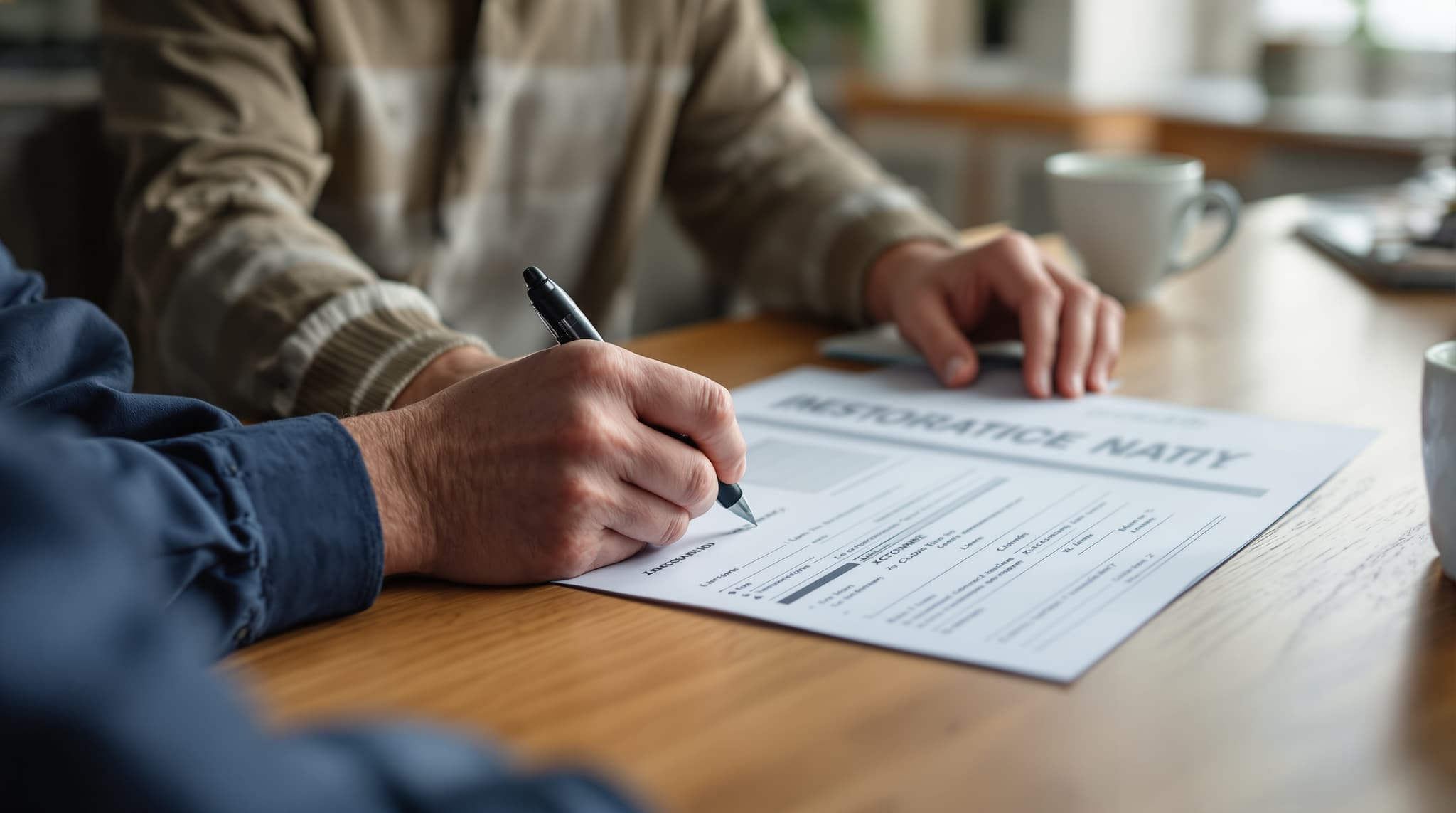
Document before you call anyone
The single biggest mistake Long Island homeowners make on water damage claims is calling the insurance company first. That is the wrong order.
The right order is: safety → documentation → mitigation call → insurance call.
Insurance adjusters show up 6 to 48 hours after the loss. By then, a good restoration crew has already extracted water, pulled wet drywall, and set drying equipment. Without pre-mitigation photos, the adjuster has to trust our word on how bad the damage actually was. That is not a fight you want to have.
What to photograph before you touch anything
- The source. Burst pipe, overflowing toilet, basement window, leaking appliance. Photograph the actual origin from three angles, including anything that shows why it happened (corroded fitting, frozen pipe, failed supply line).
- The waterline on every wall. Include a tape measure or ruler in at least one shot per room so the adjuster can verify the height.
- Every affected room, floor to ceiling. Wide shots first, then close-ups of damaged materials (flooring, baseboards, furniture, personal property).
- Personal property — appliances, electronics, rugs, stored items, boxes in the basement. If you cannot see it in a photo, the insurer will not pay for it.
- The ceiling below if water came from above. Water stains, sagging drywall, ceiling fan moisture.
- Make and model numbers of any damaged appliances. These become the evidence for replacement-cost calculations.
Shoot video too. A 60-second walkthrough with narration ("this is the living room, water came up to here, the couch was in this corner") creates a record no adjuster can dispute.
The common claim denials and how to avoid them
Insurance companies deny roughly 30 percent of water damage claims on first submission. Most denials fall into one of these buckets, and most are avoidable with the right documentation and the right mitigation partner.
| Common pitfall | How to avoid it |
|---|---|
| "You did not mitigate in a reasonable timeframe" | Call a restoration company within 4 hours of discovery. Keep the call log. The policy requires "reasonable steps to prevent further damage" — a call within 4 hours proves you did. |
| "This is wear and tear, not a sudden event" | Photograph the source before mitigation starts. Corroded pipe + visible burst point = sudden event. Slow leak over months = wear and tear (not covered). |
| "You filed too late" | File within 48 hours even if you do not have the full picture yet. You can always supplement. You cannot go back in time. |
| "This was caused by flooding" (flood is almost never covered by standard HO insurance) | Distinguish between interior-origin water (covered) and rising external water (flood — needs separate flood policy). Burst pipe = covered. Storm surge = flood policy only. |
| "Mold is excluded" | Get the restoration crew on site in under 48 hours so mold never becomes the issue. Most policies cover $5k–$10k of mold remediation IF it resulted from a covered water event. |
| "You cannot prove the value of the lost items" | Keep a home inventory. If you did not, use credit card statements, Amazon order history, and photos from other times for proof. |
| "The damage was already there" | Baseline photos of your house (before anything ever happened) are gold. Anyone with a phone should shoot a 5-minute walk-through of their house once a year. |
What to say (and not say) to the adjuster
The adjuster is a professional. They are polite, they are friendly, and they are not on your side. Their job is to close the claim at the lowest number the insurer can defend. That is not evil, it is just their job.
Things to say
- "The water started at [time] on [date] when [cause]." — specific, factual.
- "The restoration crew arrived at [time] and has documentation of pre-mitigation conditions."
- "I would like a copy of the scope of work before any repairs are finalized."
- "I will be using a licensed contractor for all repairs."
Things to never say
- "I think this might have been leaking for a while." — That is a wear-and-tear trigger phrase.
- "I tried to fix it myself." — This can transfer liability to you.
- "My neighbor had the same thing happen." — Irrelevant, and adjusters sometimes use patterns to deny as "pre-existing neighborhood condition."
- "I do not care about the damaged items, I just want the house dry." — You just gave up thousands in contents coverage.
Written communication only, where possible. Every call should be followed by an email recap ("to confirm our conversation today...") so there is a paper trail.
Direct insurance billing, and why it matters
The traditional claim process: insurer cuts a check to you, you pay the restoration company, you pay the contractor, you hope the numbers add up.
Direct insurance billing (what we do at Long Island Restoration Co.) cuts that loop. We bill the insurer directly for the mitigation work. You pay your deductible, we handle the rest. No front-loading $8,000 out of pocket waiting for reimbursement.
Here is why it matters beyond convenience: when we bill the insurer directly, we have a financial relationship with the claim. That means we will fight line items the adjuster wants to cut, because our money is on the line too. A homeowner negotiating alone with the adjuster is outgunned. A restoration contractor who bills insurers every week is not.
Ask every restoration company you call: "Do you bill the insurer directly or do you invoice me?" If they invoice you, you are about to float a five-figure bill for 60 to 90 days.
Typical payout ranges on Long Island
Claims vary, but here is what we see across Nassau and Suffolk County:
- Single-room burst pipe, clean water, caught in under 4 hours: $4,000 – $9,000 payout after deductible. Mitigation only, no reconstruction.
- Basement flood, clean or grey water, 1,000 sq ft: $12,000 – $28,000. Includes drywall cut-out, insulation replacement, flooring disposal, 5 days of drying.
- Sewage backup, any square footage: Add $4,000 – $10,000 to the above for Category 3 protocols (containment, PPE, bio-disposal).
- Mold remediation: Most HO policies cap at $5,000 – $10,000. If remediation needs exceed that cap, the homeowner eats the overage. This is the #1 argument for fast response.
- Reconstruction (separate phase): Drywall + paint + flooring + cabinets. $15,000 – $60,000+, depending on finishes. Often a separate claim phase.
Deductibles on Long Island HO policies are typically $1,000 to $5,000. Water damage deductibles are sometimes higher than standard deductibles — check your declaration page.
When to lawyer up
Most claims settle without legal help. But if you are seeing any of these flags, get a public adjuster or attorney involved before you cash any check:
- Denial letter citing "wear and tear" on a clearly sudden event.
- Payout offer that is less than 60 percent of the restoration company's invoice.
- Insurer refusing to inspect in person within 10 days.
- Policy language disputes (what is or is not a "covered peril").
- Bad faith delay — the insurer sitting on the claim past the state-mandated response timeline (New York requires a decision within 30 days of receiving proof of loss).
Public adjusters on Long Island typically charge 10 to 20 percent of the final payout. Attorneys take contingency (usually 33 percent). Both are worth it if the insurer is lowballing a six-figure claim. Not worth it on a $5,000 claim.
Call dispatch for the restoration side. Call a public adjuster or attorney for the dispute side. Keep the two conversations separate on paper.