
You need to move fast
Water damage restoration on Long Island starts with one phone call, and that call needs to happen now. Not tomorrow morning. Not after you've taken a hundred photos and searched the internet for an hour. Every hour that standing water sits in your home, it is soaking deeper into wall cavities, subfloor, and insulation — and moving you from a manageable $2,000 job toward a $10,000 one.
Long Island's housing stock is old. A lot of homes in Hempstead, Freeport, Massapequa, and Bay Shore were built in the 1940s through 1960s. The plumbing is aging. The basements are unfinished or barely finished. The sump pumps are on their second or third decade. When a nor'easter rolls through and the South Shore gets hammered, or a pipe splits in a cold January wall, you don't have the luxury of waiting until business hours.
This guide covers the full water damage restoration process — from emergency extraction through final rebuild — with Long Island-specific information on causes, costs, insurance, and mold risk.
What causes water damage on Long Island
Long Island has a specific combination of weather patterns, geography, and housing age that makes water damage a recurring issue for homeowners in both Nassau and Suffolk County.
Nor'easters and storm surge The South Shore bays — Great South Bay, Jamaica Bay, South Oyster Bay — sit directly in the path of northeast storms. When a nor'easter pushes water landfall, neighborhoods in Babylon, Bay Shore, Oceanside, Long Beach, and Freeport flood from storm surge and overtaxed storm drains. This is different from indoor plumbing failures — it's exterior water intrusion, and the volume involved can overwhelm sump pumps entirely.
Sump pump failures Most Long Island basements below the Island's high water table rely on sump pumps to stay dry. A pump that fails during a heavy rain event — whether from a power outage, a burned motor, or a float switch that stopped working — can flood a finished basement in under an hour. PSEG outages during storms make this worse. A battery backup system is the single best preventive investment a Long Island homeowner can make.
Burst and frozen pipes January and February expose the weakness in older Long Island homes: pipes routed through exterior walls, unheated crawl spaces, and uninsulated garages. When temperatures drop into the teens, pipes freeze and burst. The damage from a burst pipe depends almost entirely on how quickly it's caught — a homeowner who's home notices the ceiling dripping within 30 minutes; an unoccupied home over a holiday weekend can sustain days of continuous flow.
PSEG and utility line breaks Water main breaks from PSEG or municipality-managed service lines can push water up through foundation walls or into basements without any warning. These aren't covered the same way under standard homeowner's policies — knowing who's responsible for the line matters for the insurance claim.
Aging plumbing infrastructure Many 1950s and 1960s Long Island homes still have cast iron drain lines, galvanized supply pipes, and original shut-off valves that haven't been exercised in decades. When these fail — and they do — they fail without warning and often in hard-to-reach areas behind walls or under slabs.
The restoration process, step by step
A water damage restoration service on Long Island follows a defined process governed by the IICRC S500 Standard — the industry's professional standard for water damage restoration. Here's what that process looks like from start to finish.
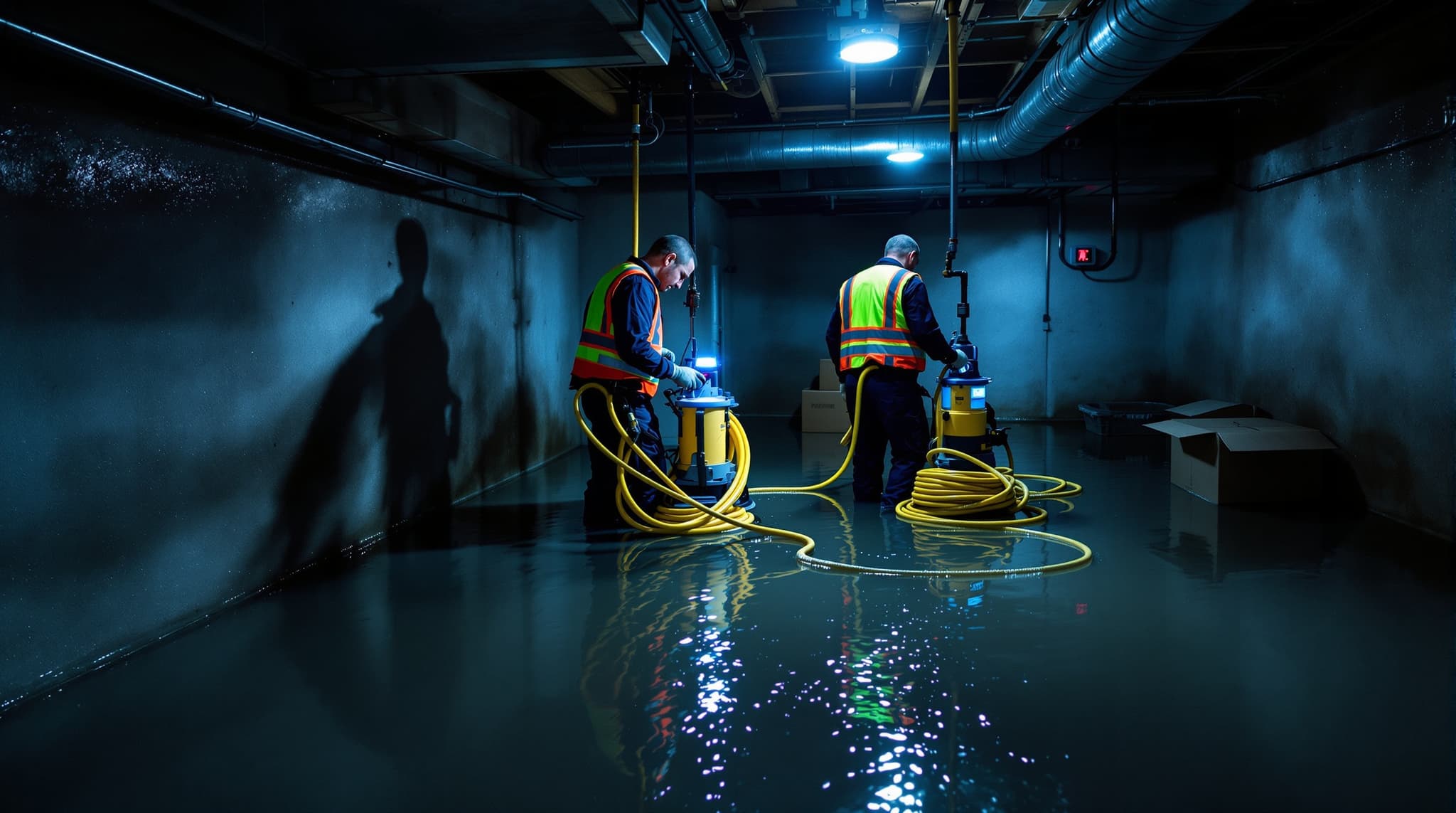
Step 1: Emergency extraction The crew arrives and immediately assesses the category of water (clean water from a burst pipe vs. grey water from an appliance overflow vs. black water from a sewage backup) and the class of damage (how much building material is affected and how saturated it is). Truck-mounted extraction vacuums pull standing water from floors, carpets, and low-lying areas. The goal is to remove water volume as fast as possible before it spreads further.
Step 2: Structural drying with industrial equipment Once extraction is complete, drying begins. This isn't fans from the hardware store — it's commercial-grade equipment: industrial dehumidifiers pulling moisture out of the air, high-velocity air movers accelerating surface evaporation, and sometimes desiccant systems in severe cases. Moisture meters measure the moisture content of walls, floors, and ceilings at every checkpoint — usually every 24 hours. Thermal imaging cameras detect moisture behind walls without cutting. Drying typically takes 3–5 days.
Step 3: Demo of unsalvageable materials Wet drywall, wet insulation, and wet carpet padding cannot be effectively dried in place and must come out. Saturated drywall loses structural integrity and becomes a mold substrate within 48 hours. Insulation compresses when wet and never recovers its R-value. Baseboards, flooring, and trim in the affected zone are removed to allow air movement inside wall cavities. Everything removed is documented, photographed, and disposed of properly.
Step 4: Antimicrobial treatment All exposed surfaces — framing, concrete, subfloor — are treated with EPA-registered antimicrobial agents. This is required on any grey or black water job and strongly recommended on clean water jobs where drying extended past 48 hours. The treatment suppresses microbial growth while the structure continues to dry.
Step 5: Clearance testing Before any rebuild begins, moisture readings must come back to normal dry standards (typically below 16% for wood framing, below 1.0% for concrete). A certified restorer signs off on structural dryness. This documentation matters for your insurance claim and protects you against future mold claims.
Step 6: Rebuild Once the structure is dry and cleared, reconstruction begins — new drywall, insulation, flooring, paint, trim, and any fixtures that were removed. The goal is to restore the space to pre-loss condition or better. On larger jobs, this phase can be quoted and managed separately.
Mold prevention: the 24-48 hour rule
Mold begins growing on wet organic materials within 24 to 48 hours under typical Long Island indoor conditions. Long Island summers are humid — July and August humidity regularly exceeds 70% — which accelerates mold colonization on wet drywall, wood framing, and carpet backing.
This is not a scare tactic. It's biology. If water sits in your walls for 48 hours before extraction begins, you are almost certainly looking at mold remediation on top of water damage restoration — which doubles or triples the job cost and requires additional containment, air scrubbers, and HEPA-filtered disposal.
Speed is the single biggest factor in both total cost and outcome. A crew that arrives in 60 minutes and gets dehumidifiers running within two hours will almost always prevent mold. A crew that arrives 24 hours later is doing mold remediation whether they call it that or not.
See our detailed guide on mold after water damage for what to do if mold is already present.
Insurance claims: how this actually works
Filing a water damage insurance claim on Long Island does not have to be a fight. Most standard homeowner's policies cover sudden and accidental water damage — burst pipes, appliance failures, and roof leaks from storm events. What they exclude:
- Flood damage from rising water — storm surge, overflowing storm drains, and groundwater seeping up through a foundation are flooding events and require a separate NFIP or private flood insurance policy. This catches many Long Island homeowners off guard.
- Gradual leaks — a slow drip that was visibly present for months before it caused damage is typically excluded as a maintenance failure.
- Deferred maintenance — a pipe that burst because it was visibly corroded and the repair was ignored is grounds for a coverage dispute.
How to document your loss Before touching anything, photograph everything. Wide shots of the room, close-ups of water lines on walls, the source of the damage, and any visible damage to personal property. If you have a moisture meter, record readings. The more documentation you have in the first 30 minutes, the stronger your claim.
What we handle directly When Long Island Restoration Co. responds to your loss, our crew arrives with moisture meters, thermal cameras, and documentation protocols designed for adjuster review. We record moisture readings at all affected surfaces, photograph the scope of damage, and produce an initial estimate formatted for your insurance carrier. We submit that estimate on your behalf and work directly with your adjuster throughout the claim — you don't manage that paperwork.
Most Long Island homeowner's policies have a $1,000–$2,500 deductible. For a covered loss, your out-of-pocket responsibility is typically just the deductible while we handle the claim with the carrier.
For a detailed walkthrough of the claims process, see our insurance claim tips guide.
What does water damage restoration cost on Long Island?
Costs vary significantly based on the scope and category of damage. Here are honest ranges based on actual Long Island jobs:
Small water loss (washing machine overflow, contained burst pipe caught quickly, single room affected): $1,500–$3,500. Extraction, drying, and minimal demo. Rebuild is straightforward.
Moderate water loss (pipe burst discovered after several hours, kitchen or bathroom flooding affecting adjacent rooms, finished basement with minor flooding): $4,000–$8,000. More extensive demo, longer drying phase, and meaningful rebuild scope.
Severe basement flood (sump pump failure during a storm, storm surge flooding, sewage backup in lower level): $8,000–$18,000. Full demo of finished basement, significant equipment deployment, possible mold remediation component, and full basement rebuild.
The biggest cost variable after category is response time. The faster water is extracted, the less it spreads, the less material is destroyed, and the lower the total cost. Emergency response fees are worth every dollar compared to the cost of a job that escalated while waiting.
For a full breakdown of cost drivers and insurance coverage specifics, see our water damage restoration cost guide.
Nassau and Suffolk County coverage
Long Island Restoration Co. covers all of Nassau and Suffolk County. Truck rolls in under 60 minutes from dispatch.
Nassau County towns and villages served: Hempstead, North Hempstead, Oyster Bay, Long Beach, Freeport, Oceanside, Valley Stream, Malverne, Rockville Centre, Merrick, Bellmore, Wantagh, Massapequa, Massapequa Park, Seaford, Levittown, East Meadow, Garden City, Mineola, Hicksville, Syosset, Plainview, Bethpage, Farmingdale, Elmont, Floral Park, New Hyde Park, Great Neck, Manhasset, Port Washington.
Suffolk County towns and villages served: Babylon, Islip, Brookhaven, Huntington, Smithtown, Riverhead, Southampton, East Hampton, Southold, Shelter Island, Bay Shore, Patchogue, Ronkonkoma, Hauppauge, Commack, Dix Hills, Melville, Northport, Port Jefferson, Coram, Medford, Shirley, Mastic, Center Moriches, West Islip, Lindenhurst, Amityville, Copiague, Wyandanch, Brentwood, Central Islip.
Frequently asked questions
How quickly can you respond to a water damage emergency on Long Island? We dispatch 24 hours a day, 7 days a week including holidays. Our target response time is under 60 minutes to any address in Nassau or Suffolk County. When you call (631) 641-5582, you reach a person — not a voicemail, not an answering service that leaves a message for the morning crew.
Is water damage restoration covered by homeowner's insurance on Long Island? Most standard homeowner's policies cover sudden and accidental water damage — burst pipes, appliance overflows, and roof leaks from storms. Flooding from storm surge or rising groundwater requires a separate flood policy. We review coverage with every new client and help document the loss in a format that supports your claim.
How long does water damage restoration take? The drying phase typically takes 3–5 days. Demo and rebuild timing depends on scope — a small contained job can be complete in under a week, while a major basement flood with full reconstruction may take 3–4 weeks from start to finish. We give you a realistic timeline at the initial assessment, not an optimistic one.
Can I just dry out the water damage myself with fans? Consumer fans move air, but they don't dehumidify it — they push humid air around an enclosed space and can actually spread moisture to unaffected areas. Industrial dehumidifiers remove moisture from the air entirely. Without the right equipment and moisture monitoring, you may think the space is dry when wet material is still present inside wall cavities or under flooring, which leads to mold. DIY drying almost always results in higher total remediation costs than professional drying from day one.
How do I know if mold is already growing after water damage? Mold can begin growing in 24–48 hours on wet drywall, wood framing, and carpet backing. You may not see it immediately — it often starts inside wall cavities. A musty odor, visible discoloration on drywall or baseboards, or water damage that sat for more than 48 hours before extraction all indicate elevated mold risk. Our thermal cameras and moisture meters can detect moisture in hidden areas, and we test at-risk surfaces before clearing a job. See our mold after water damage guide for the full picture.
What is the IICRC S500 standard and why does it matter? The IICRC S500 is the professional standard for water damage restoration published by the Institute of Inspection Cleaning and Restoration Certification. It defines the protocols for water categorization, structural drying, moisture monitoring, and documentation. Restoration companies that follow S500 standards use science-based drying targets, not guesswork. It also matters for insurance — adjusters know what compliant documentation looks like, and claims based on S500-documented work move faster and get disputed less.
Ready to get started?
Water damage restoration on Long Island is a job where every hour counts. If you've got standing water, wet walls, or flooding right now — call us at (631) 641-5582. We answer at 3am.
If the damage is documented and you're gathering information, use our contact page or request a free estimate. We'll walk through the scope, confirm what your insurance should cover, and give you a realistic cost range before any crew rolls.